Sunday, March 16, 2014

Jesus Didn't Take The Bus!

What would Jesus do if he lived here?
Well, as the brochure of the Jesus Trail states “Jesus didn’t take the bus.” So we do the same - we walk the Galilee while we are here.

We booked this hike through the JesusTrail Tours, which means we still hike just with the two of us, but they arranged our overnight accommodations along the trail, the meals AND they transport our luggage. A perfect arrangement. 
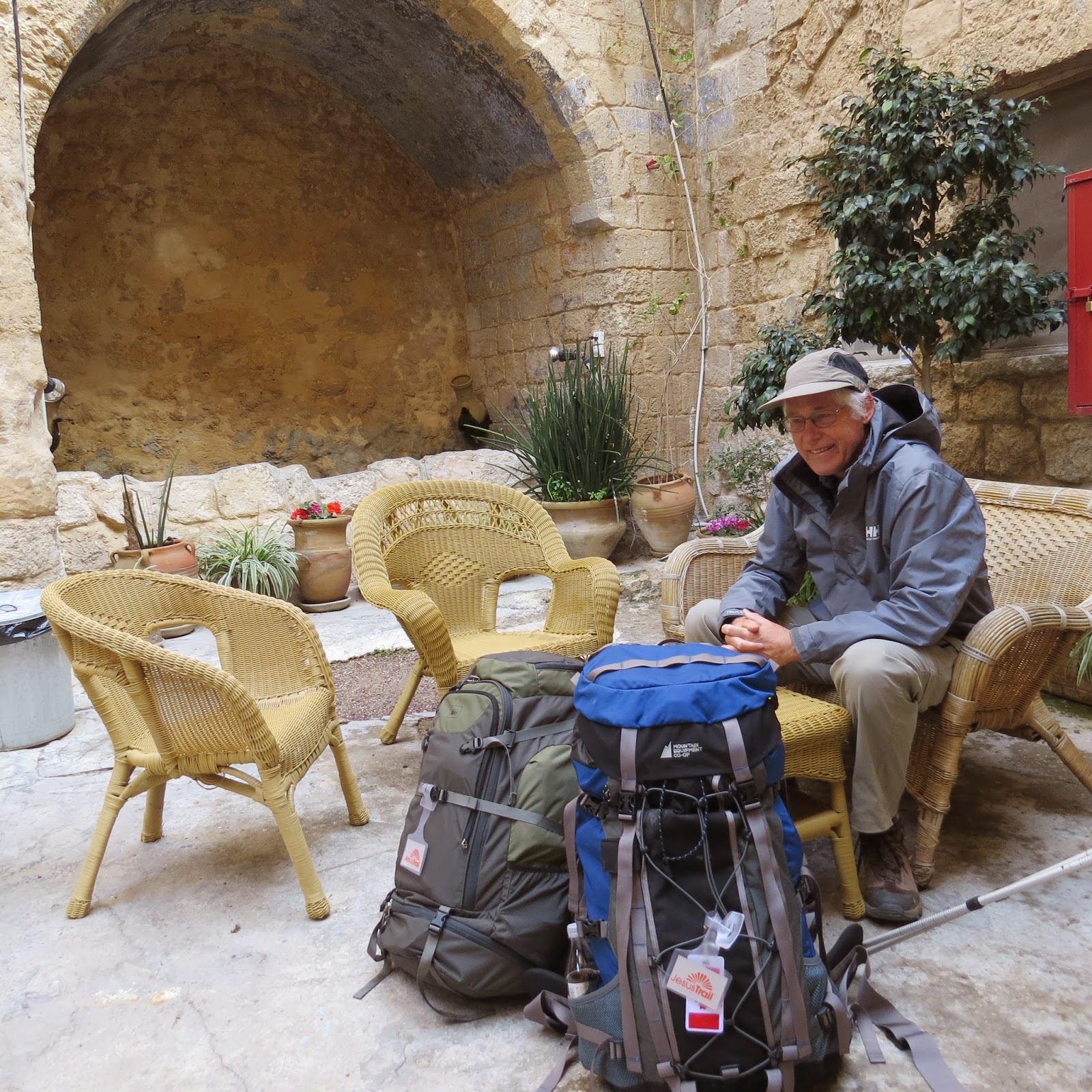
Fauzi Azar Inn: Kees zit bij de pakken neer.

Leaving Nazareth this morning, we followed the orange trail markers, through the alleys of the old city, up 350 steps and out of the city. The trail took us through old olive groves and yellow fields of mustard seed.

Whenever we pass through a town, children and adults alike called out ‘hello’ and ‘Shalom’! These are Arab children and ‘shalom’ is a foreign word so they yell it at foreign visitors. Everyone is very welcoming and kind.
We had a snack of nuts and fruit outside the gates of Zippori, a historic national park including Roman ruins dating back to 700 BC.

Then we headed down into the city of Cana where Jesus reportedly performed his very first miracle: turning water into wine at a Cana wedding feast. Now, Cana proudly displays jars of clay (as in the famous music group Jars of Clay) and sells mineral water as Cana wine... or perhaps they bottle real wine.

There are two churches, a Catholic one and an Oxthodox church right next to each other, each claiming to be the original site. Our guest house in Cana is immediately next to the churches. The very welcoming Arab Israeli hosts served us fresh lemonade, made from the lemons in the backyard, before showing us a room.

It is interesting to note that Arabs and Jews still live in very separate areas of town, if they even share a town. Cana has a Christian side and a Muslim side. Some towns only have one or the other but not both. Apparently they get on well enough on the surface, but many nuances play a role in the deeper understanding of how both cultures mix or don’t mix.
Our host just came and served us Turkish coffee. Tonight they will serve us a traditional dinner. 
Stay tuned for tomorrow's adventure as we spend the night at an orthodox kibbutz. Not sure if there will be wifi.
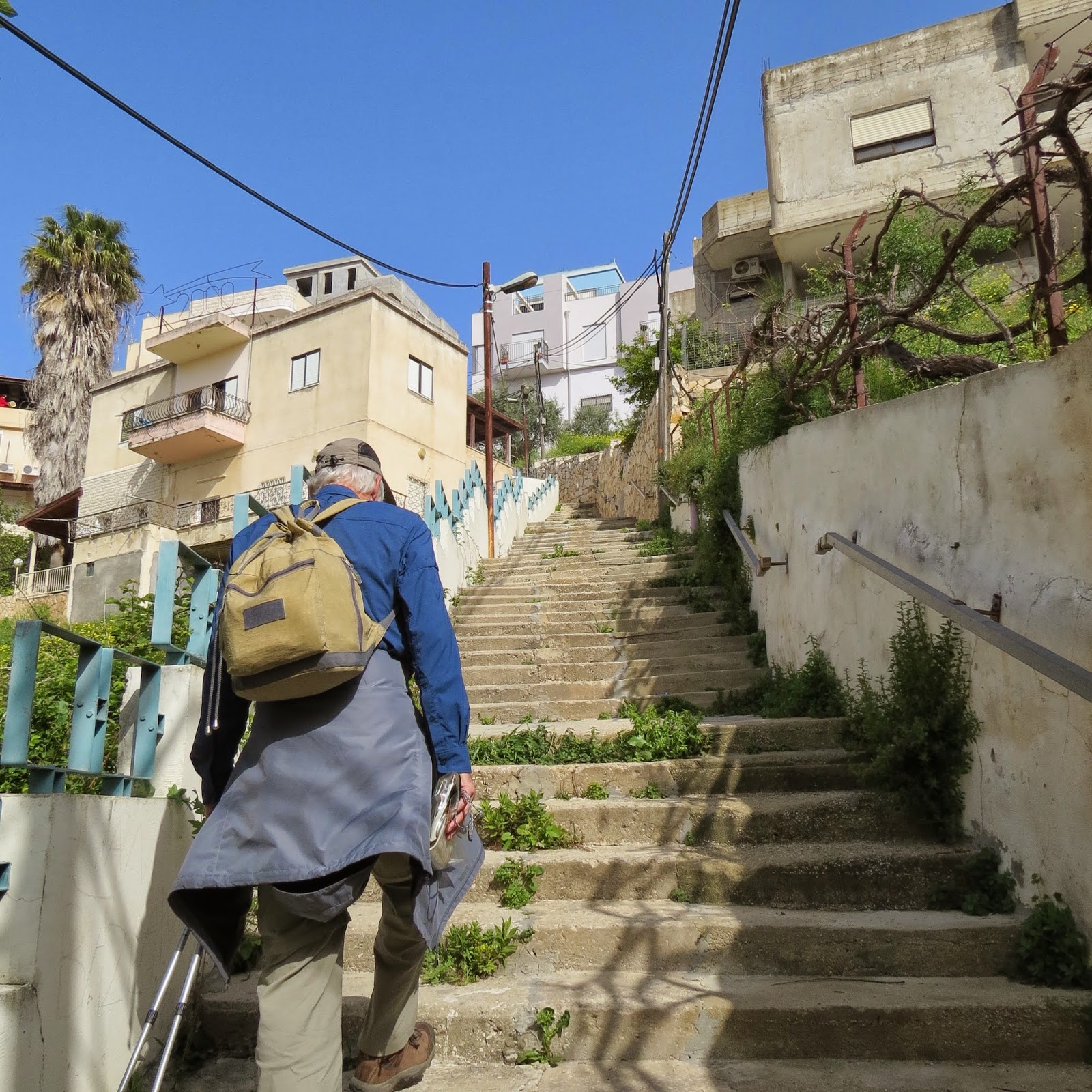
350 steps up and out of Nazareth

Yellow fields of mustard seed outside the city.

Wild cyclamen

Enormous cacti everywhere.

Cana, the city of the first miracle.


Saturday, March 15, 2014

Coffee and donkeys in Nazareth

Nazareth has churches and mosques side by side
After a week at a wonderful international school near Hertzliyya, we are now in Nazareth.
donkey in Nazareth
We are happy to be staying in the old parts of cities, which have a very authentic, and much different, feel from the 'modern' parts of cities. Here, no busses and motorbikes race by. It is quiet because there  is no traffic. The roads are alleys, just a few meters wide, if that. They are steep, often with steps. Here the alleys also have gutters for run-off, making it awkward to walk. When the market stalls are open, and goods spill out into the street, there is not enough room for all of the people making their way up and down the hilly town. Here, among the vegetable and fruit vendors, it is easy to imagine how Jesus walked these same narrow roads.


We followed our noses to the coffee and spice vendor, bought Turkish coffee in a small stall and walked to the Church of the Annunciation where, according to Christian belief, the angel Gabriel told Mary of her immaculate conception.
The skyline of Nazareth is filled with churches, mosques and minarets. We were surprised to learn that no Jews live in this Arab city, but make their home in nearby Nazareth Ilid.
We had fantastic fried pancakes filled with cottage cheese and pecans, and drenched in honey.


We bought bread and fruit for our upcoming long distance hike and did our laundry. The hotel in which we are staying is a fun, ancient inn. Our room has stone arches and feels like an old wine cellar... The courtyard is full of birds and plants, even a lemon tree.
Old olive tree

This afternoon we visited Nazareth Village, an open air museum where the time of Jesus is reenacted in the village and farm style, clothing and way of living. Only 500 meters from old Nazareth, they have unearthed an ancient wine press area in the rocks, as well as terraced farm land. Old, gnarled olive trees shelter the sheep and donkey that roam around while children play in period clothing and adults demonstrate herding, a guard station, weaving and more. There is even a carpenter named Joseph...  Everything is very enjoyable and interesting. Except the gift shop which sells plastic baby Jesus dolls.

We found a great restaurant where we've gone back twice for dinner: Tishreen Restaurant: http://tishreen.rest-e.co.il


Check out: http://fauziazarinn.com     
                     
In our next blog, find the answer to the famous question: What Would Jesus Do?

Baby Jesus dolls for sale!


Shepard in Nazareth Village
Nazareth Village

  
Weaver


Amazing - apparently they had cameras in the 1st century!

Sunday, March 9, 2014

Rules You Can Sleep By!

Roof top patio of Hashimi Hotel
The hotel in which we are staying in Jerusalem is pretty amazing. I found it on the internet. Checked out bookings.com, Orbitz, and more but also the website of the hotel itself. It looked nice. It was in the old city, which I wanted. I also looked at AirB&B, hostels and more. But this place sounded like it was a reasonable price, in the old city, and had everything we were looking for. 
We happened to see the sign: Hashimi Hotel!
Until we arrived, I had NO idea that 'in the old city' means that you can only get here on foot. I wonder how many older people are in for a shock. It's at least 10 minutes walking through a maze of alleys. Now I know why I never saw a photo of the outside of the building. There is only a front door, squeezed between a falafel place and a little shop. But once you open the door, up you go - marble staircase after marble staircase. Narrow and up. The first floor is a lobby with a desk, and with old, heavy wooden furniture where you can sit and have tea or coffee.
Jerusalem is all stairs - inside and out.
We are on the next floor in a room not much bigger than the bed. But it has a private tiny bathroom with shower. And, unlike many places in the old city, it actually has warm water.
There are no windows except for a tiny window onto the hallway. This makes the place a bit noisy. The men are very loud and we often wake up to loud voices and laughter in the hallways.
Fresh baked bread everywhere.
On the 3rd floor is a place to have breakfast: falafel, hard boiled eggs, tomato, cucumber, hummus, cheese and lovely flaxseed cookies.
On the 4th floor is the best feature: a large roof top terrace. This might well be the only hotel in the old city where you can sit and look out over the entire city. Our view is over rooftops, minarets, church bells, the white graves of the Mount of Olives and the golden, glistening Dome of the Rocks. Couldn't be better. We sit here day and night, gazing at the surreal panorama.

 Last
So much colorful food!
night we were invited to join the hotel's workers for a dinner of a huge platter with a kind of potato curry, with vegetables on the side. They all dipped in with fingers and with pita bread. Too bad we had just eaten...
If you ever come to visit here, we do recommend Hashimi Hotel, with all its quirks and personality. The owners live part time in the US and speak perfect English.

In Spain, Kees was lucky if he found something to eat, anywhere, before 9 PM.
Here, at least in Jerusalem, we are lucky if we can still find a restaurant open at 6 PM, many close so early. We are in the Muslim Quarter and the restaurants seem to all serve the same food. One of the best things is the freshly squeezed juice: oranges, grapefruits, anything. They just put it in a large squeezer and voila! For dinner each night we have about six different salads (creamy cucumber, creamy tomato, something identified on one menu as 'colslo' - meaning coleslaw - hummus, pita bread and sheskabab of lamb or chicken. No beer or wine. The Muslim Quarter is dry.

It's interesting to note that the 'H' in hebrew is pronounced as a 'G' - a harsh, Dutch guttural 'g'. So a town named HaHaGaNa is pronounced Ga-a-gana. Today someone who passed us said "Ghai!" instead of 'hi'!


Leaving Jerusalem to return to the coast, we found a great taxi driver who jovially offered to drive us not just to the train station but all the way past Tel Aviv and to the door of the hotel, for less than half the normal cost because he had to go that direction anyway. He entertained us with loud stories, using his arms and hands more for storytelling than for driving. When he heard we were from Canada, his face lit up. "Ah! Solomon!"
I wrecked my brain for biblical knowledge of Solomon. "Fresh Solomon," he continued throwing his arms up and forward as if reeling in a big catch, "You go fishing for fresh solomon?"  Ah, salmon...
We bought fresh bread, juicy strawberries and fresh juice for lunch.
The taxi drove through the corridor, from Jerusalem to the rest of Israel,  through the Westbank. Both sides protected by huge concrete walls and barbed wire fences, with the occasional check point to cross into the Westbank. It reminds us of the Berlin Wall.
And it is in sharp contrast to the people who are all so kind and outgoing - the Palestinians, the Jews, the Arabs and the Christians. All are so friendly and welcoming to us.


Saturday, March 8, 2014

Bethlehem: no manger, no inn - just Starbucks!

Jaffa Gate, Jerusalem 

Street in Bethlehem

The best advise we can now give anyone wanting to visit Bethlehem: don't book a tour!
For months we had studied websites and travel guides. We had read all about the many different companies and the types of tours you can book. You can choose from one day tours or half days. Each advertises with the fact that "all admissions are included but not lunch." The average tour costs between US $75 and US $100.- per person.

Since we couldn't decide, we figured we'd wait till the last minute and book something once we got to Jerusalem. Once here, we discovered that we could simply take the "Arab bus", just outside the Damascus Gate and a five minute walk from our hotel, from Jerusalem to Bethlehem for 8 shekels (less than $3). There ARE no admissions anywhere. We did not have to move in a large group of tourists all day. Apparently the line-ups for individuals are shorter than for tour groups AND a shop owner told us "You are on your own? No tour bus? No guide? Ah! I gave you 30% discount!" So this day cost us a lot less than if we had opted for a tour.

We had fun going on the bus with many locals but also a fair number of westerners. On the way out of Jerusalem we noticed lots of Orthodox Jews wearing traditional large black hats, long curls, prayer shawls. It is Shabbat so many were walking along the streets. When it rains lightly, out came large plastic covers for the huge fur hats.

Bethlehem is more like a suburb, and very similar to Jerusalem in that it is a big, crowded city with lots of traffic. No cute little manger or inn in sight!
Not even signs to Manger Square. But we only walked the wrong way once.
It rained for a few minutes and the age-old streets are slippery as ice - smooth worn stones.
Lots of little shops selling nuts, sponges, leather ware, spices. One man with an enormous jug was selling Turkish coffee in the street.

Manger Square, Bethlehem
We made it to Manger square where there are many shops, restaurants, a bank, even a Starbucks! There are some old remnants of walls but much is newly build.
The grotto where Jesus is said to have been born, is covered by a church that has seen different religions and has been restored numerous times. Like many historic places, this slightly diminishes its authenticity for us. But the people are so interesting to watch. I noticed today how similar Catholic nuns in their long black robes and white headgear, look to Palestinian women who often wear the same long black skirts and tight, white head dress.

We watch wood carvers make handmade items like smoothly sanded crosses and mangers from olive wood. And we admired beautiful Palestinian hand embroidered clothing. Even though there is nothing Christmassy in sight, in Bethlehem, it felt very special to walk along these thousands year old streets, among people whose work, food and clothing does not seem to have changed a whole lot since then. Except for cell phones and wifi everywhere. And halogen bulbs in the old candelabra of the Church of the Nativity - signs of the times.
Halogen bulbs are a sign of the time in Church of Nativity


Friday, March 7, 2014

Jerusalem - a Feast for the Eye


I find that I don't have enough eyes, here in Jerusalem.
The people, the buildings, the crooked alleys full of color. I don't know where to look first.
We traveled here by bus and train. Everywhere, people approach us asking how they can help. When we wear our big backpacks, they can easily see we are visitors. Strangers say 'welcome to Israel', 'welcome to the Holy Land' as we pass by. One train conductor really went out of his way and brought us a schedule, told us where to stand, talking very loudly he attracted a crowd. Then he whipped out his cell phone and shared photos of a cheesecake, saying he really liked to bake. Ha. Everyone was in stitches.


From the train station we splurged on a taxi to the 'old city'. My suspicions were confirmed at the old Damascus Gate: no traffic at all within the old city walls because
there are no roads! Through an absolute maze of alleys often not more than 3 meters wide, we tried to swim upstream against a solid stream of muslims in headscarves, running children, salesmen selling leather bags, rugs, oranges, nuts, spices, breads and kitchenware. Nuns and monks joined the steam, as did tourists speaking many languages. Orthodox Jews, Palestinians, everyone shoulder to shoulder.
The stones have been worn smooth by millions of feet over hundreds and hundreds of years.

Amazingly, we found a door, suddenly in the alley, to our hotel. Hotel Hashimi is three stories tall, rising above the shops and alleys with a fabulous rooftop garden. Our room is almost the same size as the bed, but the rooftop terrace makes up for the lack of space to move around. We sit here gazing out over the Mount of Olives, with its thousands years old graves, as well as over the mount of historic streets that is old Jerusalem. The jewel in this crown seems to be the golden roof of the Dome of the Rock. My favorite moment came when the Christian church bells chimed over the city, joined by the melodious chant of the Muslim call to prayer. If only people lived together as easily as these symbolic sounds.

Children run and play everywhere. It is hard to image growing up in this dark, cool maze of steps and alleyways. The vendors, by and large, do not praise their wares. But you are expected to hackle over prices. We ate fried chicken, wonderful creamy hummus and warm pita bread. Today I asked for pomegranate juice and the guy sliced four large, ripe ones and plunged them in a squeezer.

We joined the throng of people entering the Church of the Holy Sepulchre - the holiest site for Christians, this is the purported site of Jesus' crucification, his burial site and the site of the grotto of resurrection. The light steaming into the church itself, the endless stream of faithfuls approaching the sites, the dusty stone corridors and staircases, all add to the special feeling that hangs in the air.

 A highlight came when, once outside and following more alleys, corners and stairs, we stumbled upon the Western Wall, or wailing wall. Having seen photos of it for so long, it seemed surreal to be standing here. The people are fascinating and my photographer's heart beats faster, trying to capture their beautiful faces - shadows on the wall, children with prayer books. Rabbis were chanting, groups were debating, men rocked back and force, seemingly arguing with the wall.


On the way back, a stream of nuns, monks and Christians came by singing and chanting the Lord's Prayer. It is amazing to me how they live together, albeit uneasily I'm sure, and how each group seems to want the same: love their God and have a home and a healthy family.

Thursday, March 6, 2014

Hiking in Spain

 While Margriet is freezing her butt off in the Yukon and Toronto I (Kees) decide to find a warmer place to go hiking for a few weeks.
Via Seattle and Paris I make my way to Amsterdam but as soon as I arrived in Amsterdam I noticed how cold it was and miserably windy. My luggage took an extra few hours (and a few more flights from Paris) to arrive and in the mean time I inquired about flights to Spain (southern Spain where it was supposed to be warm). When I finally had my luggage I went into Adam and found the usual hotel on the Overtoom. The next day I tried to get a sim card for all of Europe, but in spite of the fact that you can get those via internet, I could not find an acceptable one in a store. Apparently they are available from some British web sites, but the ones available in A'dam were way too expensive. So I am taking my changes with the wifi in the hostels and B&B's I am staying at.

The next day I found a cheap flight to Malaga in southern Spain and three hours later I was standing between the palm trees. First a bus ride into downtown and a hostel next to the bus station. That evening I had supper at 10 pm outside on a patio because it was so nice and warm. The next day I first wandered through Malaga, especially the old part of the city, was quite nice. That afternoon I took a bus into the hills above Malaga and ended up in a small very cute village called Competa. Found a small B&B stayed there 3 damn cold nights. It was a beautiful old renovated olive mill, more a museum than a hostel, but cold, damp and hardly any heat to speak of. I was probably the first guest there this season and the thick walls had absorbed all the cold from the entire winter and was releasing it on me every night. The plaza in the village had several restaurants and I tried every one. unfortunately they did not start serving supper until about 8 pm, nor could I get breakfast before 8 am. Everything is closed between about 2 and 5 and if you are hungry or thirsty during those times you are out of luck.
The Local tourist office had lots of information about hiking in the hills and for 2 days I found beautiful (very steep) trails through the mountains without my backpack because i spent 3 nights in the same place. The next day I packed up and walked to another village, unfortunately I ran into a bees nest and got stung several times before I got away from it. Stayed overnight in a village high up on a pass, the coldest I have been all winter, including SSI. The next day I went back down and stayed in a B&B from a Dutch couple. A 200 year old farm house which again is cold as ice, but at least the beer and food are good.
In many places I find my English is understood and in some cases I understand their Spanish as long as they use lots of hand gestures. The maps I have to walk on are poor and yesterday I got lost pretty good, but as long as you stay to the roads and not wander off into the hills you are OK.
When I got 5 bee stings a few days ago, I hitch-hiked to the next village and that was no problem. I wrote on a piece of paper the name of the village and the driver dropped me off there. He would not accept any money. The cost of living here is dirt cheap. The hostels are between 20 and 35 euros ( $30-50) and an evening meal is between 8 and 15.
For the last few days of my two week hiking adventure I took a bus down to Malaga and spent 2 days hiking in the old city and surrounding hills. Southern Spain is a wonderful place to spend a few weeks hiking but February is still pretty cold much of the time unless you hug the coast.

Age Old Adventures

 In the last 3,000 years, we were about the last ones to discover Caesarea.
Having flown into Tel Aviv, we took a train into the city where we had booked an apartment for one night. We found train, bus and taxi to take us there. No key as promised so we woke up the manager by calling on a borrowed cell phone. Turned out the key was hiding in a couch, not in the mailbox where we were told we would find it.

It was a bit of a shabby place but served its purpose. The next morning, our first in Israel, we walked along the beach of the Mediterranean Sea to Old Jaffa - a beautiful sea port, with thick walls and crooked little streets.
After a shake of fresh oranges, melon and banana, we collected our luggage and took a small bus (almost too small for our large backpacks) to the bus station where we headed north to the kibbutz. We had kindly been invited by someone we’ve never met, to stay here in a small cottage. Kibbutz Sdot Yam turned out to be a lovely park setting dotted with houses and schools. Lots of little children and dogs run rampant. Our little cottage is run down but cute - with a comfy bed and a tiny kitchen. We picked up soup, bread, tea and other essentials and love having our own little place here.


The beach is gorgeous. I even had a little swim. On Wednesday, we set out to explore the area and discovered that we are right in an area that has been highly contested by many civilizations.
Some 2,000 years ago, ruling Roman emperor Herod decided it was an ideal location for a port. He had walls and a fortress built here, and a complete city with baths, towers, an amphitheater and more.

Subsequently, Jews fought to control the city, and were conquered by Byzantine armies, who were overthrown by Muslims, and then by Crusaders. Others came and went. Walls fell down. Towers caved in and were restored. Synagogues made way for cathedrals that were razed in favor of mosques.


Roman columns lay strewn everywhere
Now, the crumbling walls and remnants of this age old city called Caeasarea, is in the backyard of Kibbutz Sdot Yam. We walked along the old seats of the amphitheater and the arena where chariots used to race. Marble columns lay strewn among building blocks of coral. A great movie and a fantastic hologram display explained the history to us and introduced us to rabbis and emperors throughout the ages. Caesarea is a National Park we much enjoyed.
I feel 18 again as we backpack around Israel.

Check out: http://www.caesarea.com/en/home/tourism-and-leisure/harbor/general-info/caesarea-harbor-national-park-map